
Use the DIME method to find your ideal coverage in 60 seconds. Then compare quotes from 30+ A-rated carriers.
Last reviewed September 2026 by Dev Gaymes, Texas-licensed life insurance agent, NPN 16654074 · Editorial policy
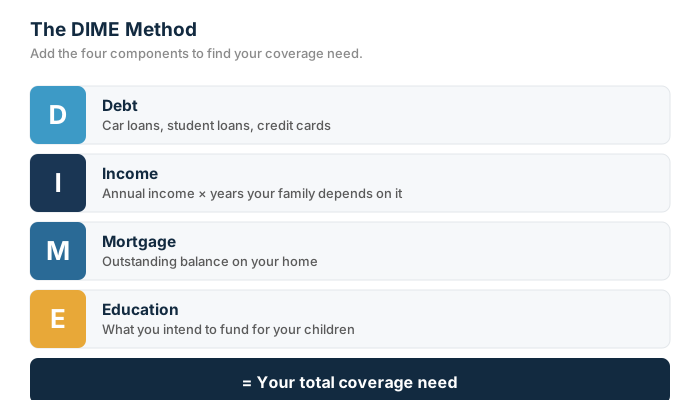
We generally recommend 5 to 10 times your annual income, and that covers income replacement only. Your debts, mortgage balance and education costs are added on top, then existing coverage and savings are subtracted. That is the DIME method: Debts + Income replacement + Mortgage + Education. A family earning $75,000 with a $280,000 mortgage starts from $375,000 to $750,000 for income, plus the $280,000 mortgage, before debts and college. Use our free calculator below to find your number in under 60 seconds.
Estimate your ideal coverage using the DIME formula - takes under 60 seconds.
DIME is a formula that calculates life insurance needs based on four factors: Debt, Income, Mortgage, and Education. It produces a more useful number than any single income multiple because it separates income replacement, which we generally put at 5 to 10 times annual income, from the obligations that sit on top of it.
Your Number = Total Debts + (Annual Income × Years Needed) + Mortgage Balance + Education Fund − Existing Coverage & Savings
For example, a family with $40,000 in debts, $75,000 income (10 years needed), a $280,000 mortgage, $100,000 education fund, and $50,000 existing coverage would need: $40K + $750K + $280K + $100K − $50K = $1,120,000. That may sound like a lot, but a healthy 35-year-old can get a $1M 20-year term policy for approximately $45–$75/month.
Coverage needs change dramatically throughout life. Here are recommendations by life stage, drawn from client work since 2012:
Lock in low rates while healthy. Covers co-signed loans, student debt, and funeral costs. Premiums rise with every year of age, so buying young fixes a lower rate for the whole term. Worth considering even before you have dependents.
Cover your shared mortgage, joint debts, and income replacement. Separate policies with living benefits riders protect against serious illness too. Both spouses need their own coverage.
The critical stage. Income replacement at 5 to 10 times salary, plus the mortgage, childcare, and any college you plan to fund. Use the calculator above for your exact number.
Biggest coverage gap stage. Layer a large term (income replacement) with permanent coverage (estate + cash value). Living benefits and IUL become especially valuable for care planning.
Shift to estate planning and surviving spouse income. Convert expiring term to permanent. Living benefits riders can take on part of the long-term care job, though they are not a full substitute for standalone LTC insurance. See our comparison →
Final expenses ($10K–$25K), legacy gifts, and surviving spouse supplement. Guaranteed issue requires no health questions, at a higher premium and usually with a two-year graded benefit. Read advance planning guide →
A healthy 30-year-old non-smoker can get $500,000 of 20-year term life insurance for approximately $20–$35 per month. Rates increase with age: a 40-year-old pays $30–$50/month, and a 50-year-old pays $65–$120/month for the same coverage. Women typically pay 15–25% less than men. These are real rates from the 30+ carriers we represent.
| Age | $250K / 20-Yr Term | $500K / 20-Yr Term | $1M / 20-Yr Term |
|---|---|---|---|
| 25 | $12–$18/mo | $18–$28/mo | $30–$50/mo |
| 30 | $14–$20/mo | $20–$35/mo | $35–$60/mo |
| 35 | $16–$24/mo | $25–$42/mo | $45–$75/mo |
| 40 | $22–$32/mo | $30–$50/mo | $55–$95/mo |
| 45 | $30–$48/mo | $48–$80/mo | $85–$150/mo |
| 50 | $45–$72/mo | $65–$120/mo | $120–$225/mo |
| 55 | $70–$115/mo | $110–$200/mo | $200–$380/mo |
| 60 | $120–$190/mo | $180–$340/mo | $340–$620/mo |
Estimates for healthy non-smokers. Actual premiums vary by carrier, health, and underwriting. We compare 30+ A-rated carriers against your profile.
Yes. A stay-at-home parent provides childcare, household management, cooking, transportation, and other services valued at $35,000–$60,000+ per year. If that parent dies, the surviving spouse must pay for these services while still earning income. Most advisors recommend $250,000–$500,000 for a stay-at-home parent. Both spouses should have their own separate policies.
For the income portion, often yes. We generally recommend 5 to 10 times your salary to replace income, and 10 times sits at the top of that range. But that covers income only. A mortgage, other debts and any college you plan to fund are added on top, which is why a family with a mortgage and young children can need well beyond 10 times salary in total. Use our calculator above to add each piece separately.
Employer coverage is a good start but rarely enough. Most employer policies provide 1–2× your salary, well short of 5 to 10 times income for income replacement alone, before the mortgage and debts are counted. Employer coverage also ends when you leave the job, and you can't take it with you. A personal policy stays with you regardless of employment changes. Subtract your employer coverage from your DIME calculation to find the gap, then fill it with a personal term or permanent policy.
Term life is the most cost-effective choice for most families. It provides the highest coverage per dollar and can be matched to your mortgage length. Whole life adds cash value and lifetime coverage but costs 5–10× more for the same death benefit. Many clients use a combination: a large term policy for income replacement plus a smaller whole life for estate planning and cash value growth. Read our full policy comparison →
We strongly recommend adding a living benefits rider to any policy. This lets you access a portion of your death benefit while alive if diagnosed with a critical illness (heart attack, stroke, cancer), chronic illness, or terminal illness. The funds are generally income-tax-free under IRC 101(g) when the policy's conditions are met, and can cover medical bills, mortgage payments, or lost income during recovery. Many carriers include living benefits at no extra cost. Read our full living benefits vs. LTC guide →
For most families: a 20- or 30-year term policy with a living benefits rider, sized using the DIME formula. Add permanent coverage as your estate grows. We compare 30+ A-rated carriers - schedule a free call or see instant term quotes.
Life Insurance Guide - Term vs. whole vs. universal compared by life stage
Living Benefits vs. LTC - How they compare, and which situations suit each
Mortgage Protection Guide - Got a mailer? See why term life is the smarter choice
Pricing Page - Cost ranges by policy type from 30+ carriers
Advance Planning - Estate planning, wills, trusts, and legacy protection
General insurance information on this page reflects standard industry practice. Texas policy forms and rates are filed with the Texas Department of Insurance; model regulations are maintained by the NAIC. Dev Gaymes is a licensed Texas producer, NPN 16654074, verifiable through the NIPR national producer database.
Rate disclosure. Premiums shown are illustrative estimates for healthy non-smokers and are not a quote or an offer of coverage. Actual premiums depend on age, health, tobacco use, coverage amount, term length, state, carrier, and underwriting approval. Rates and product availability vary by carrier and by state.
A 30-year-old typically needs $250,000-$500,000 if single with debts, or $500,000-$1,000,000+ if married with children. At age 30, a healthy non-smoker can lock in a 30-year term policy for $20-$35/month for $500K coverage.
A 40-year-old parent often needs $500,000 to $1,500,000: income replacement at 5 to 10 times salary, plus the mortgage, childcare and education costs. At Preferred non-tobacco rates, $500,000 of 20-year term was about $34.64 a month for a 40-year-old man in Texas in September 2026 (illustrative, not a quote).
Parents with children at home typically need $500,000 to $1,500,000 or more. Factor in 18+ years of dependent care, childcare costs ($30,000-$60,000/year), college tuition ($25,000-$50,000/year per child), mortgage, and income replacement.
At Preferred non-tobacco rates quoted in Texas in September 2026, $500,000 of 20-year term was about $24.92 a month for a 35-year-old man, $34.64 at 40, $53.23 at 45 and $82.62 at 50 (illustrative, not a quote). Your price depends on the rate class you qualify for, and comparing across 30+ carriers lets you see the range.
Term life insurance is the most affordable type. Lock in rates while young and healthy. No-medical-exam policies offer faster approval at competitive rates. Using an independent broker who compares 30+ carriers ensures you get the lowest available premium.
