
A first child changes this answer more than any other life event. Here is how to work out the number for a Dallas household, and what to do when it is bigger than you expected.
A first child changes the answer to this question more than any other life event. Before, life insurance was optional for a lot of households. Now someone genuinely cannot replace what you provide, and they cannot do it for roughly two decades. Here is how to work out the number, and how to think about it when the full figure is more than you want to spend.
Most people do this backwards: they pick a round figure that sounds responsible, or take whatever the employer plan offers, and never calculate the actual need. Start with the arithmetic.
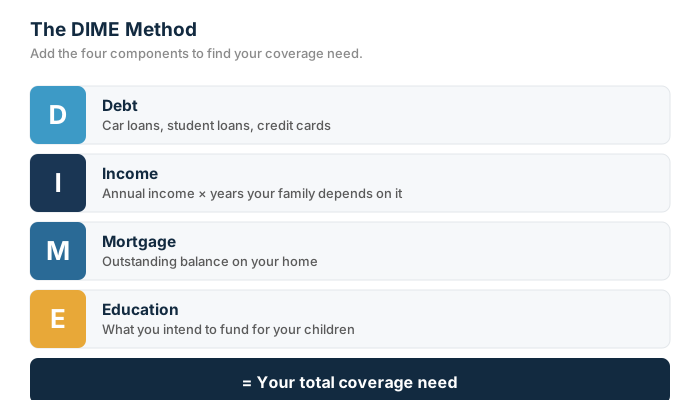
The DIME method is the common framework - Debt, Income, Mortgage, Education. Worked through for a Dallas household with a newborn:
Illustrative calculation only, using assumed figures for demonstration. Not a quote and not a recommendation. Your own numbers will differ. Run yours with the coverage calculator.
Adjusted this way, the example household lands somewhere between $750,000 and $1.3 million, which is affordable at a young age in a way the full figure may not be.
The most common gap we see in new-parent households is coverage on only one parent, usually the higher earner. That leaves a real exposure.
If a stay-at-home or lower-earning parent dies, the surviving parent has to replace what that person was doing, and most of it costs money:
Illustrative figures for demonstration only. Childcare costs vary widely by provider and age of child.
A policy on that parent is usually smaller than on the primary earner. It should not be zero.
A 20-year term bought the year your child is born expires when they are 20: potentially still in college and not financially independent. A 30-year term carries them past that, and at a young age the difference in premium is usually modest.
Pregnancy does not prevent you from getting coverage, but it complicates underwriting: blood pressure and weight change, gestational diabetes can appear, and some carriers postpone a decision until after delivery. Applying before conception or early in the first trimester generally produces the cleanest result.
There is also the plain arithmetic of age. Rates are locked at issue, so every year of delay is priced in permanently:
Hypothetical illustration for a $750,000 20-year level term policy using an assumed rate curve. Not any carrier’s rates, not a quote, and not a prediction of your cost. See real rates - no email or phone number required.
The arithmetic above works anywhere. These three factors change the inputs for a Dallas household specifically.
1. No state income tax changes both sides of the calculation. Texas households keep more of the same gross salary than families in most states. That raises the amount your family would actually need to replace. They are accustomed to the take-home, not the gross, and it means a given premium is more affordable here than the same premium would be in a state taking another five to nine percent.
2. Texas is a community property state, and that reaches your beneficiary designations. Where community funds pay the premiums, a spouse may have a claim to proceeds even if someone else is named. It also matters after a divorce: Texas Family Code Section 9.301 voids an ex-spouse designation on individually owned policies, but federal ERISA law overrides it for employer plans, so your work coverage can still pay an ex-spouse. How Texas law actually handles this.
3. Your school district changes the education number. The DIME calculation includes education, and what you plug in depends on your plan. A family in Highland Park ISD or Carroll ISD is generally solving for college only. A family planning private school from kindergarten is solving for a much larger figure across a longer period. That single input can move the total by several hundred thousand dollars, and it is worth deciding deliberately rather than defaulting.
Do not name your child as beneficiary. Insurers generally will not pay a death benefit directly to a minor. Doing so typically triggers a court-appointed guardianship over the money - slow, costly, and out of your family’s control. The usual structure is spouse as primary with a trust as contingent, or a trust named outright. More on beneficiary designations, and worth an attorney rather than a guess.
Name a guardian in your will. Life insurance handles the money. It does not decide who raises your child, and that is a separate document. Families frequently do one and not the other.
You will be offered one. Being direct: a child has no income to replace, so for most families this is not a priority.
The arguments made for child policies. Guaranteed future insurability and locking in a low rate - have some merit. They matter far less than making sure both parents are adequately covered. If the budget is finite, and it usually is, every dollar goes to the parents first.
A common starting framework is the DIME method: total your Debts, Income replacement (we generally recommend five to ten times annual income), Mortgage balance, and Education costs you intend to fund. For a household earning $95,000 with a $340,000 mortgage and a newborn, using five to ten times income for the income line, that math lands roughly between $960,000 and $1.44 million before existing coverage and savings are subtracted. Many families buy less than the full figure and cover the most critical years rather than every year, which is a reasonable trade as long as it is a deliberate choice rather than an accident.
Usually yes, including a parent who does not earn an income. Replacing what a stay-at-home or lower-earning parent contributes is a real and immediate cost. Childcare alone commonly runs $15,000 to $20,000 a year per child in the Dallas area, and that is before household management, school logistics and everything else. A policy on that parent is typically smaller than on the primary earner, but it should not be zero.
Ideally before, or early in, the pregnancy. Pregnancy itself does not prevent you from getting coverage, but it can complicate underwriting: blood pressure and weight change, gestational diabetes may appear, and some carriers postpone a decision until after delivery. Applying before conception or in the first trimester generally produces the cleanest result. If you are already further along and healthy, it is still worth applying rather than waiting.
Match the term to the need rather than to a round number. A 20-year policy bought when your child is born expires when they are 20, which may be before they are financially independent. A 30-year term covers them through college and early adulthood and usually costs only modestly more at a young age. Many households ladder instead, a longer policy covering the mortgage and long-term income, with a shorter policy layered on for the years when costs peak.
Almost never. Group life is typically one to two times salary, often with a hard dollar cap, which rarely covers a mortgage plus five to ten years of income replacement. It also ends when the job does. The usual approach is to keep the employer-paid basic coverage, which costs you nothing, and add an individually owned policy sized to the actual gap.
This is worth being direct about: a child has no income to replace, so the honest answer for most families is no, not as a priority. The arguments made for child policies are guaranteed future insurability and locking in a low rate. Those have some merit, but they matter far less than making sure both parents are adequately covered first. If the household budget is finite, every dollar should go to the parents before a child policy is considered.
No, not directly. Insurers generally will not pay a death benefit to a minor, and doing so typically forces a court-appointed guardianship or conservatorship over the money, which is slow, costly, and takes the decision out of your family's hands. The usual approaches are naming your spouse as primary beneficiary with a trust as contingent, or establishing a trust and naming that. This is worth a conversation with an attorney rather than a guess on a form.
Less than most people expect. Life insurance rates are set by your age and health when the policy is issued, and new parents are often in their late twenties or thirties, which is among the cheapest times to buy. The most common regret we hear is not that someone bought too much coverage; it is that they waited a few years and paid more for every year afterwards.
It depends on the household rather than the city, but Dallas inputs push the number in a specific direction. Mortgages here are substantial relative to income in most family neighborhoods, infant childcare commonly runs around $18,000 a year, and Texas having no state income tax means a family is accustomed to more take-home from the same gross salary, so the amount being replaced is larger than the gross figure suggests. Running the DIME framework on a Dallas household with a newborn, using five to ten times income for the income line, produces a total of roughly $960,000 to $1.44 million, though many families deliberately buy less.
Dev Gaymes is a licensed insurance broker, not an attorney. Beneficiary designations, trusts and naming a guardian are legal matters governed by state law - consult a qualified attorney. General education, not advice about your situation, and not an offer of insurance or a quote. All calculations and premium figures shown are hypothetical illustrations using assumed values for demonstration; they are not any carrier’s rates, do not represent any specific policy, and will differ from your own situation. Beneficiary designations, trusts and guardianship arrangements are legal matters - consult a qualified attorney. All coverage is subject to carrier underwriting approval, and policy terms, benefits, exclusions and limitations are governed solely by the issued policy contract.